Pieskowa Skała Castle
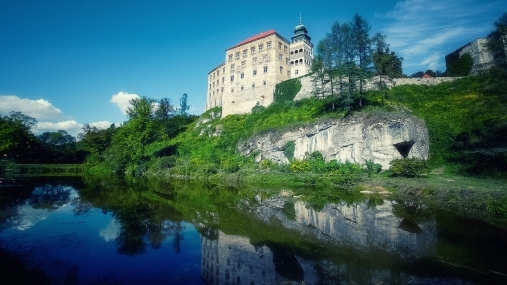
Pieskowa Skała Castle beyond any doubts deserves to be called the phoenix of Polish castles. During its turbulent and long history, it has deteriorated many times, was conquered, burned, and yet each time it was reborn from the ashes. The first mention of this historical castle can be found in one of the documents of Polish king Władysław Łokietek from 1315. However, it was mentioned under a different name than the one we know today - Peskenstein. Most likely, the king did not mean the building known to us today, but the fortifications performing a similar function near the nearby village of Sułoszowa. Defensive fortifications in this area were created to protect the Prądnik valley - the main route connecting Kraków with Silesia. The castle in its current location was built during the reign of king Casimir the Great in the first half of the 14th century. At that time, it consisted of a watchtower located on a rock promontory. On an inaccessible rock, bearing the graceful name Dorothy, there was the highest castle tower, which served residential functions. The farm buildings surrounded by defensive walls were probably located in the vicinity of the modern courtyard of the castle.
Szafraniec family
This complex was in royal hands until the end of the 14th century, when king Louis I of Hungary gave it to Piotr Szafraniec, a deputy pantler of Kraków. Interestingly, this donation was not at all due to the special merits of the deputy pantler, but it was compensation for the wounds he suffered as a result of the dispute with the Hungarian courtiers of the king. Eventually, the castle was handed over to the son of Piotr, also Piotr, by king Władysław Jagiełło. The Szafraniec family maintained a strong position around the Polish throne for a long time, and its members held the highest offices in the country. During their times, the castle underwent subsequent expansions: two huge artillery towers were built, and the popularity of Italian fashion resulted in a Renaissance reconstruction. Another significant figure in the history of Pieskowa Skała was the voivode of Sandomierz, Stanisław Szafraniec, who, after spending his youth at the court of Prince Albrecht Hohenzollern, returned to the country as a Calvinist. He became a spokesman for religious tolerance in Poland and a significant protector of Polish Protestants, including an outstanding Polish poet Mikołaj Rej. In the times of Stanisław, the castle was enriched with an arcaded courtyard, a loggia and gardens. Unfortunately, with the death of his son Jędrzej in 1608, the male line of Szafraniec family died out, and the castle passed into the hands of other families.
Later history
In the 17th century, the starost of Lanckorona, Michał Zebrzydowski, as a devout Catholic, enriched the castle with a magnificent chapel of St. Michael and carried out a thorough renovation of the outdated defensive elements of the castle. Despite the renovation, the castle fell victim to military operations during the Swedish Deluge, when it was destroyed and looted by the invaders. Subsequent renovations were associated with a sudden inflow of funds from the salt mines in Bochnia and Wieliczka. Unfortunately, over time, it lost its Italian cloisters and loggias, impractical in Polish conditions, but gained an outstanding interior design during this period. In 1850, the castle was destroyed by another fire - this time its consequences turned out to be tragic and 3 years later, the upper castle located on Dorothy's Rock collapsed due to damage. In the 19th century, the heavily neglected castle was taken over by a joint-stock company specially established to save it, which allocated it to a luxury guest house. Due to ending up in Russian part of partitioned Poland the castle lost its close ties with Krakow, and became the destination of trips for the inhabitants of Warsaw and the entire Russian part of divided country. The guest house functioned in the years 1903-1939. During World War II it was given for an orphanage where hundreds of children, mainly from the eastern borderlands, found their shelter.
Modern times
When the fog of war settled the castle was nationalized and handed over to the Ministry of Agriculture. In 1950 it changed hands once again and was given to the Ministry of Culture and Art. Thanks to architectural research, it was possible to reveal Renaissance architectural elements and reconstruct the arcaded courtyard and observation loggia. The development of the castle was entrusted to the Wawel Royal Castle State Art Collection. In 1970, the gates of Pieskowa Skała were opened to tourists. Since then, the castle has been undergoing not the fires but repairs and renovations, and the place itself has become a real gem of Polish museology. In 2023, the castle opened its doors to geocaching.
Castle grounds entrance
In order to find this geocache it is needed to visit the castle grounds which(except Mondays - the days of free admission) is paid. The cheapest ticked is 16PLN (reduced price 13PLN) and includes the guided tour to the cloisters, Dorothy's Rock and warehouse. Paying for the ticket is required in order to find this geocache but using the guide service itself is not obligatory - After entering the castle, you can leave the group and freely solve the quiz. The final cache itself is also hidden on the castle grounds.
Entrance is possible every 20 or 30 minutes at the following times:
- Monday - 9:00-17:00
- Tuesday-Friday - 9:20-17:00
- Saturday, Sunday, National holidays - 9:30-18:00
Hours may change due to the public holidays. Always up-to-date list of changes can be found at: Pieskowa Skała Castle Geocache In order to find the cache, you need to read the listing, solve 2 simple quizes and visit the courtyard of the Pieskowa Skała Castle. Quiz no. 1 is recommended to be solved from home, but you can do it while already visiting the castle too. Puzzle no. 2 requires you to visit the courtyard and solve it there.
Quiz 1:
Read the cache listing and solve the quiz from the link below:
Link to quiz no. 1.
This quiz will provide you with the code to the LEFT padlock and the north coordinates of the cache.
Quiz 2:
Visit the Pieskowa Skała castle courtyard and answer the questions from the quiz below:
Link to quiz no. 2.
This quiz will provide you with the code to the RIGHT padlock and the east coordinates of the cache.
After finding the cache please make sure that you're leaving everything exactly as you found it. Do not confuse the padlocks and do not play with them, make sure that all the containers are in the right place so they won't be crushed by the cover. As a reward, take the finder's certificate from the marked container.
Entrance is possible every 20 or 30 minutes at the following times:
- Monday - 9:00-17:00
- Tuesday-Friday - 9:20-17:00
- Saturday, Sunday, National holidays - 9:30-18:00
Hours may change due to the public holidays. Always up-to-date list of changes can be found at: Pieskowa Skała Castle Geocache In order to find the cache, you need to read the listing, solve 2 simple quizes and visit the courtyard of the Pieskowa Skała Castle. Quiz no. 1 is recommended to be solved from home, but you can do it while already visiting the castle too. Puzzle no. 2 requires you to visit the courtyard and solve it there.
Quiz 1:
Read the cache listing and solve the quiz from the link below:
Link to quiz no. 1.
This quiz will provide you with the code to the LEFT padlock and the north coordinates of the cache.
Quiz 2:
Visit the Pieskowa Skała castle courtyard and answer the questions from the quiz below:
Link to quiz no. 2.
This quiz will provide you with the code to the RIGHT padlock and the east coordinates of the cache.
After finding the cache please make sure that you're leaving everything exactly as you found it. Do not confuse the padlocks and do not play with them, make sure that all the containers are in the right place so they won't be crushed by the cover. As a reward, take the finder's certificate from the marked container.